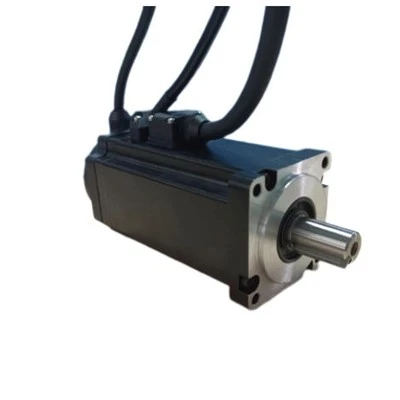
Where to Buy a DC Servo Motor: A Practical Guide for Industrial Buyers
Searching for a DC servo motor is relatively easy. Finding the right motor for an industrial machine is more difficult.
For OEMs, robot manufacturers and automation-equipment builders, the purchasing decision should not begin with price or supplier location. It should begin with the motor architecture, load requirements, drive voltage, feedback system and mechanical interface.
There is also an important terminology issue. Today, "DC servo motor" can refer to different products. Some buyers use the term for traditional brushed DC servo motors, while others use it when looking for low-voltage brushless servo motors powered from a DC bus.
These are not the same type of motor. Before requesting a quotation, it is worth defining exactly what the machine needs.
First: What Do You Mean by a DC Servo Motor?
A traditional brushed DC servo motor uses brushes and a commutator for mechanical commutation.
These motors are still used in some existing machines and specialized systems, but brush wear creates a maintenance requirement.
Modern industrial low-voltage servo systems are often different.
A permanent-magnet brushless servo motor may operate from a 24 V, 48 V or other low-voltage drive platform while using three-phase U/V/W motor windings and electronic commutation through a servo drive.
This distinction matters when replacing an existing motor. A request such as "I need a 48 V DC servo motor" is usually not enough information to select a replacement.
The supplier still needs to know whether the motor is brushed or brushless, what drive is being used, what encoder is installed and what torque and speed the machine requires.
What Should You Know Before Contacting a Supplier?
A good servo-motor enquiry does not need to be complicated, but several parameters are particularly useful.
Rated Power
Rated power gives the supplier a basic idea of motor size, but it should not be used alone. Two motors with the same rated power can have different torque, speed and inertia characteristics.
Rated and Peak Torque
Torque is often one of the most important specifications in a servo application. Rated torque describes continuous operating capability, while peak torque is relevant during acceleration, deceleration and short overload periods.
Speed
Provide the normal operating speed and, where relevant, the maximum speed. This allows the supplier to check whether the required torque is available across the actual operating range.
Load Inertia
Inertia affects how the servo axis accelerates, decelerates and responds to control commands. This is why industrial servo products are commonly offered in different inertia classes rather than being selected by wattage alone.
Drive Voltage
Specify the servo-drive platform already used in the machine. A mobile robot may use a low-voltage architecture, while industrial production equipment may use a 220 V or 380 V servo system.
Encoder
The encoder must be compatible with the servo drive. Depending on the machine, this may include incremental, absolute, optical, magnetic or resolver feedback.
Brake
If the motor is used on a vertical axis or needs to hold a load when power is removed, a holding brake may be required.
Mechanical Dimensions
For a replacement project, flange size, shaft diameter, shaft length and motor body length are often just as important as electrical specifications. Sending the existing motor drawing is usually the fastest way to avoid mechanical compatibility problems.
Where Can Industrial Buyers Purchase Servo Motors?
There are several purchasing channels, but each serves a different type of customer.
1. Buy Directly from the Motor Manufacturer
For an OEM project, replacement program or customized machine, purchasing directly from a manufacturer is often the most practical route.
The main advantage is not simply price. A manufacturer can usually discuss motor selection, winding and voltage requirements, encoder configuration, holding-brake options, shaft and flange dimensions, protection requirements, sample validation and production quantities.
This becomes especially important when a standard catalogue motor does not fit the existing machine exactly.
For repeat OEM production, direct communication with the motor manufacturer also helps reduce the risk of specification changes between prototype and volume production.
2. Buy Through an Authorized Distributor
A distributor can be useful when local inventory, local-language support or short delivery time is the main priority.
For standard replacement motors, this may be faster than starting a new OEM project directly with a factory.
A distributor may also provide local application support. The trade-off is that customization options can be more limited, and technical changes may still need to be confirmed with the original manufacturer.
3. Use Industrial Marketplaces Carefully
Industrial marketplaces can be useful during the early sourcing stage. They allow buyers to compare suppliers, approximate pricing and available product ranges.
However, a catalogue listing should not replace technical confirmation. For servo motors, buyers should verify the actual manufacturer, exact motor model, datasheet, torque-speed curve, encoder specification, dimensional drawing, drive compatibility, warranty and technical support.
This is particularly important for replacement projects where two motors may look similar but use different feedback interfaces or electrical parameters.


What Jiangnan Electric Currently Offers
Hangzhou Jiangnan Electric Motor Co., Ltd. currently provides permanent-magnet servo motors across several voltage platforms, frame sizes and inertia categories.
The current product structure separates the portfolio into Low-Inertia, Medium-Inertia and High-Inertia Servo Motors. This is more useful for machine selection than grouping every low-voltage product under a single "DC servo motor" label.
Low-Inertia Servo Motors
Jiangnan's low-inertia range includes D, E, A and B Series products. The B Series provides a low-voltage platform, including 48 V configurations, while the A Series covers higher-voltage applications.
The catalogue identifies low-inertia products for applications such as SCARA robots, delta robots, AGVs and medical robots.
For example, the 40B Series includes a 0.1 kW version with 0.32 N·m rated torque, 0.96 N·m peak torque and 3,000 rpm rated speed. The product platform also includes 24 V and 48 V drive configurations, encoder options and IP65 protection.
For smaller equipment, Jiangnan also offers compact servo products such as the 20E and 25E Series. The 25E range includes 11 W, 22 W, 33 W and 50 W versions on a DC48 V platform, with rated speed up to 3,000 rpm and peak speeds up to 6,000 rpm depending on configuration.
Medium-Inertia Servo Motors
The C Series forms the current medium-inertia range.
The catalogue specifies a 24–72 V platform and identifies industrial robots and material-handling robots among its intended applications.
It also supports multiple feedback options, including incremental encoders, absolute encoders and resolvers.
This type of motor can be useful where the mechanical load requires a different inertia balance from a very low-inertia motor.
High-Inertia Servo Motors
For applications with larger load inertia, Jiangnan also offers D, E and S Series high-inertia servo motors.
The current catalogue describes high-inertia products with peak torque capability up to approximately three times rated torque, speeds up to 6,000 rpm for relevant series, and multiple magnetic encoder options.
These products are intended for applications including collaborative robots and higher-payload industrial robot systems.
Do Not Select a Servo Motor by Voltage Alone
One of the most common purchasing mistakes is searching only for "24 V servo motor," "48 V servo motor" or "220 V servo motor" and choosing from voltage alone.
Voltage only tells part of the story. Two 48 V motors may have very different rated torque, peak torque, speed, rotor inertia, encoder, frame size, shaft dimensions and thermal performance.
The motor and servo drive must also work together as a complete system.
For this reason, the fastest procurement process usually begins with the existing machine data rather than a generic product search.
What Should You Send with an RFQ?
For an industrial servo-motor quotation, the following information is usually sufficient for an initial evaluation:
- application or machine type;
- rated power;
- rated and peak torque;
- rated and maximum speed;
- drive voltage;
- load inertia, if available;
- encoder requirement;
- brake requirement;
- shaft and flange dimensions;
- operating environment;
- expected quantity.
For a replacement motor, sending the existing nameplate, dimensional drawing and servo-drive model is particularly useful.
If all three are available, the supplier can usually determine much more quickly whether an existing motor series can be used or whether customization is required.
Manufacturer or Distributor: Which Should You Choose?
The answer depends on the project.
For an urgent standard replacement, a distributor with local stock may be the most convenient option.
For an OEM machine, non-standard motor or recurring production requirement, working directly with the manufacturer generally provides more flexibility for technical confirmation and customization.
For early supplier research, industrial marketplaces can help identify candidates, but technical approval should still be based on drawings, specifications and sample validation.
The purchasing channel matters, but the quality of the technical matching matters more.
Start with the Application, Not the Product Listing
A servo motor is part of a complete motion-control system.
Before asking where to buy one, define what the machine actually requires.
Torque, speed, inertia, drive voltage, feedback device and mechanical dimensions are usually more useful than a simple request for a "DC servo motor."
For OEM and replacement projects, Jiangnan Electric can review an existing motor nameplate, drawing, servo-drive information and machine requirements before recommending a suitable low-, medium- or high-inertia servo configuration.
Disclaimer
The information in this article is provided for general reference only. Product specifications, performance, configuration options and suitability must be evaluated in detail for the intended application and actual operating conditions. Before selecting, purchasing or using a product, please confirm the relevant details with Jiangnan Electric and refer to the applicable technical documentation and agreed specifications. This article does not replace product-specific instructions or a professional engineering assessment.