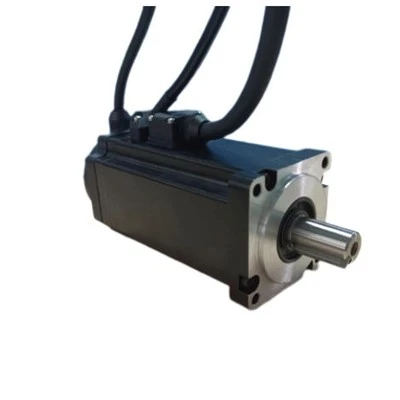
Servo Motors for AGVs and AMRs: What to Check Beyond 48V
Consider a warehouse robot that pulls away with a load, slows for a turn, docks at a station and returns for the next job. Some versions also lift a rack or turn a separate steering module. Those movements place different demands on the motors, even when they share the same battery.
For manufacturers of automated guided vehicles (AGVs) and autonomous mobile robots (AMRs), a 48 V servo motor can be a practical starting point. The useful question is whether the motor, drive and transmission can handle the intended job throughout the working day. [2]
Identify the Motion Axis First
Traction motors move the vehicle. Their requirements depend on the robot's total operating mass, wheel diameter, travel speed, acceleration, gradients and rolling resistance. Payload alone is not enough to select them.
On vehicles with a separate steering axis, the motor has a different task: positioning the wheel assembly rather than continuously propelling the chassis. A lifting mechanism brings another set of requirements, including how the load is supported when drive power is unavailable.
Do not assume one motor specification suits every axis simply because all three use a 48 V system. Confirm the job of each motor before comparing frame sizes or prices. [1, 3]
Check the Battery's Operating Range, Not Just Its Label
A nominal battery voltage is not a constant voltage at the drive terminals. Check the fully charged voltage, the lowest permitted operating voltage and any drop during demanding movements. The motor-drive combination must still provide the required motion across that range.
The brushless servo motor is not connected straight to the battery. A compatible servo drive converts the DC supply into controlled motor-phase currents. Both the drive's input limits and the motor's operating requirements need to be checked.
Deceleration deserves attention too. A motor can return energy to the DC bus while slowing a load. Whether the battery can accept that energy depends on the battery, its management system and the drive arrangement. Confirm what happens when charging is restricted or the battery is already full; do not assume every stop will recharge it. [2, 4, 5]
Evaluate a Working Shift, Not One Successful Run
A short bench test does not reproduce repeated loaded starts, long travel periods or operation inside an enclosed chassis. Test the proposed motor in a representative installation and check temperature and current over the expected duty cycle.
Battery runtime also needs a system-level check. Motor current and battery current are different quantities because the drive converts power between its input and output.
For example, the 400 W entry in Jiangnan Electric's 60B catalog table lists 12.8 A rated motor current. That is not a prediction of average battery draw. Dividing battery capacity in amp-hours by that number would not establish the robot's runtime. Use measured battery-side consumption over a representative route, including the robot's other electrical loads. [6, 7]
Reserve Space for the Complete Assembly
The motor body is only part of the installation envelope. Allow space for the gearbox, shaft connection, brake, connectors and cable bends. The shaft and bearing arrangement must also suit the mechanical loads; a standard motor shaft should not automatically be treated as a vehicle wheel axle.
The 60B mounting drawing provides a useful example. For the 400 W configuration, the cataloged motor-length dimension changes from 124 mm without a brake to 165 mm with a brake. That difference can matter beneath a low-profile chassis, before any allowance is made for the transmission or cables.
Check the brake's intended duty separately. A holding brake is primarily for keeping an axis stationary, not for repeated service braking unless specifically rated for it. Selecting a motor with a brake does not, by itself, establish the vehicle's safety performance. [7, 8]

Jiangnan Low-Voltage Servo Options to Review
Jiangnan Electric's servo catalog identifies the low-voltage B Series for AGV applications. The following catalog configurations provide starting points for an engineering review, rather than complete wheel-drive or vehicle specifications. [7]
|
Motor family |
Cataloged drive voltage |
Rated power options |
Rated speed |
|
60B |
48 V |
200 / 400 / 600 W |
3,000 rpm |
|
80B |
48 V |
750 / 1,000 W |
3,000 rpm |
|
60C |
48 V configurations shown |
100 / 200 / 400 / 600 W |
3,000 rpm |
Catalog examples only. The listed electrical and mechanical ratings do not establish an AGV or AMR payload capacity.
The 60C belongs to the medium-inertia range, which the catalog positions for industrial and material-handling robots. It is a separate option to review where its dimensions and operating characteristics suit the axis, not a direct substitute for a B Series motor.
These speeds are motor-shaft speeds, not wheel speeds. The transmission and wheel diameter still determine vehicle travel speed and wheel torque. Suitability for a particular AMR, steering unit or lifting mechanism must be confirmed for that application.
The B-Series 80 product page on Jiangnan's website provides a related product reference. For ordering, use the approved configuration drawing and motor data rather than treating a family name as a complete specification. [7, 9]
Keep Motor Feedback and Vehicle Control Separate
The motor's encoder must work with the chosen servo drive. Communication between that drive and the vehicle controller is a separate interface to confirm.
Selecting a particular encoder does not automatically give the motor CANopen, EtherCAT or a navigation function. Likewise, precise shaft feedback does not guarantee accurate docking on its own. The vehicle's mechanics, traction, sensors and control system also influence the result.
Confirm which supplier provides the motor, drive, gearbox, brake and control functions. Clear supply boundaries help prevent missing components and incompatible interfaces from appearing during assembly. [1, 3, 7]
Send the Vehicle Layout with the Motor Inquiry
For a first review, send Jiangnan Electric the axis function, battery voltage range and drive model, together with the available mounting space. For a traction axis, include total vehicle mass with payload, wheel diameter, target speed, maximum gradient and transmission ratio, if already selected.
A description of the working cycle is equally useful: how often the robot starts, how far it travels under load and whether it also lifts or steers. Add the brake requirement and any shaft-load or environmental constraints.
Before moving from samples to production, agree on the exact motor configuration and a vehicle-level validation plan. A sample that fits and rotates is only the beginning; the selected arrangement needs to meet the robot's operating requirements throughout its intended battery range and working cycle.

Source Notes
[1] maxon - Drive systems for mobile logistics robots
General application context: traction duties, integration, installation constraints and vehicle-level validation. Not evidence of Jiangnan capabilities.
[2] Kollmorgen - AKM2G & AKM Low Voltage DC Servo Motors
Industry example of low-voltage servo platforms for battery-operated mobile robots. No cross-brand compatibility is implied.
[3] Kollmorgen - AC7 and DC7 Motor Controllers
Separates steering/traction control, motor interfaces and vehicle communication.
[4] Novanta Motion - Power Supply and Motor Power (Capitan XCR)
Drive supply limits and voltage headroom for regeneration. Numerical drive limits from this source are not applied to Jiangnan products.
[5] Novanta Motion - Protections
Regenerative energy and battery acceptance conditions.
[6] maxon Support - EPOS4 / IDX: Checking the motor current draw
Motor current is not the same quantity as controller supply current.
[7] Company-supplied English Servo Catalog
Source file: 伺服电机宣传页(英文)(1).pdf. PDF p.10 (printed p.01): B Series application statement. PDF pp.29–30 (printed pp.20–21): 60B electrical data and brake/no-brake dimensions. PDF p.34 (printed p.25): 80B data. PDF pp.36–38 (printed pp.27–29): C Series applications and 60C data/dimensions.
[8] Kollmorgen - Holding Brake
General distinction between standstill holding and repeated operational braking; vehicle safety needs separate assessment.
[9] Jiangnan Electric - B Series 80 Frame Permanent Magnet Servo Motors
Public product reference for the 48 V B Series. Use the approved configuration for final ordering; see the discrepancy note in Publishing Notes.
Disclaimer
The information in this article is provided for general reference only. Product specifications, performance, configuration options and suitability must be evaluated in detail for the intended application and actual operating conditions. Before selecting, purchasing or using a product, please confirm the relevant details with Jiangnan Electric and refer to the applicable technical documentation and agreed specifications. This article does not replace product-specific instructions or a professional engineering assessment.