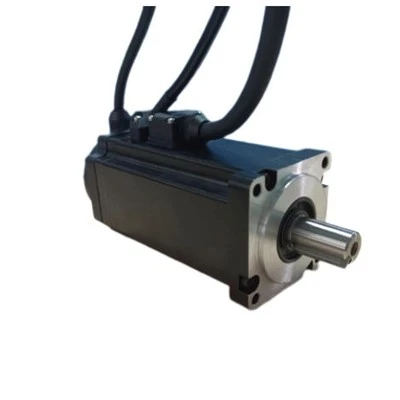
Servo Motors for Electric Grippers: Start with the Workpiece
Our 20E servo motor catalog lists a 30 W, 24 V configuration with 0.096 N·m rated torque at 3,000 rpm. For a compact electric gripper project, that is useful motor data. It is not a gripping-force rating or a statement of how much weight the fingers can hold. [1]
At Jiangnan Electric, we recommend starting the discussion at the other end of the mechanism: the workpiece. What must be picked up, where can the fingers make contact, and what movement follows? Those answers help turn a request for a small servo motor into a requirement that can be evaluated.
Define What a Successful Grip Looks Like
Consider a thin plastic housing. Holding it securely is only part of the task; the fingers must also avoid marking or distorting it. A metal component of the same weight may need a different gripping arrangement because its shape and contact surfaces differ.
For a friction grip, part weight alone is not enough. Contact friction and the robot's acceleration also affect the force needed to keep the part from slipping. Provide the part drawing, contact locations and handling orientation, together with any limits on allowable deformation. [3]
Translate Finger Requirements into Motor Requirements
Motor torque is expressed in newton-meters; gripping force is expressed in newtons. A screw, gear train or linkage connects the two. Its geometry and losses influence how much motor torque is needed to produce the required force at the fingers. [2]
Finger travel needs the same attention. The motor's rpm does not directly tell you how quickly a jaw will close. Ask the gripper designer to establish the motor-shaft torque and speed required by the proposed mechanism. Where these are not yet available, send the mechanism drawing for review rather than selecting a motor from wattage alone. [2]
Two Compact Servo Families to Review
Our catalog includes the following small permanent-magnet servo configurations. They are starting points for a motor-level discussion, not prequalified electric grippers.
|
Catalog family |
Listed voltage |
Rated power options |
Rated speed |
|
20E |
24 V |
10 / 20 / 30 W |
3,000 rpm |
|
25E |
48 V |
11 / 22 / 33 / 50 W |
3,000 rpm |
Source: Jiangnan / Zhongke Servo English catalog, PDF pages 13 and 19. Values apply to the configurations listed on those pages. Confirm the selected motor and compatible drive before ordering. [1]
Neither row establishes a jaw stroke, grip force, payload or closing time. Those are properties of the completed mechanism. A larger power rating is not, by itself, evidence that the gripper can handle a heavier part.

Include the Time Spent Holding the Part
A gripping cycle includes more than opening and closing. The fingers may stay still while the robot transports the part or waits for another operation. If motor torque is required to maintain the grip, current can still flow while the shaft is stationary. That holding period belongs in the thermal and duty-cycle review. [4]
Describe the complete sequence: approach, close, hold during movement, release and wait. Ask whether the motor's required standstill torque is permitted for the intended duration and cooling conditions. Do not assume a short demonstration of closing the fingers covers a full production shift. [4]
Keep Motor Feedback and Grip Confirmation Separate
The 20E catalog drawing identifies U/V/W motor power leads and separate encoder wiring. The motor therefore needs a compatible drive; it is not a complete gripper that can be operated simply by applying 24 V to its motor leads. [1]
Motor position feedback can support jaw-position control through the mechanism. It does not, on its own, verify that the correct part is securely gripped. Part detection, force control and communication with the robot belong to the complete gripper-control design. Confirm which sensing and control functions the project requires instead of assuming they are supplied with the motor. [5]
Send Us the Workpiece and Mechanism Together
For an initial discussion with Jiangnan Electric, send the workpiece drawing, intended gripping points, jaw travel and opening or closing time. Include the mechanism layout, available motor space, drive information and holding duration. Describe the intended response to a stop or power loss; the gripper's designer must establish how the workpiece will be retained or released.
Our servo motor range and catalog provide component options to review against those requirements. Any proposed motor needs confirmation for the specific gripper design, followed by testing of the assembled tool. An existing catalog entry is not evidence of a validated gripper application. [1, 6]
Before approving a configuration, check the actual parts through the intended handling sequence, including representative variations in size and contact condition. The useful result is a grip that works for the workpiece and process-not just a motor that fits inside the housing.
Sources and Publication Checks
EDITORIAL REFERENCE - SEPARATE FROM THE BLOG BODY
[1] Jiangnan / Zhongke Servo English catalog
伺服电机宣传页(英文)(1).pdf; PDF pp. 13–14 and 19–20. Primary basis for the 20E and 25E entries, the 20E 30 W operating point, and its motor/encoder wiring. The catalog does not provide a completed-gripper force, payload or cycle rating.
[2] SCHUNK - EGA-W 25-060-R-N-B
Technical background: a gripper specification separates jaw force and stroke from required motor torque/speed, and identifies the mechanical transmission. No SCHUNK product rating or compatibility claim is assigned to Jiangnan motors.
[3] Robotiq - Hand-E instruction manual, Specifications
Technical background: friction grasp, contact conditions and robot acceleration affect allowable payload. No force value, formula or example from this manual is reproduced in the article.
[4] Kollmorgen - Technical Data Terminology
Technical background: standstill torque/current and temperature rise. Use Jiangnan's model-specific data for any actual sizing or holding-duty approval.
[5] SCHUNK - PGN-plus-E product documentation
Technical background: motor actuation, gripper-level force adjustment, sensors and communication are distinct functions. Used to check system boundaries, not to imply Jiangnan supplies the same functions. Source
[6] Jiangnan Electric - Servo Electric Motors / Request a Quote
Company product context and inquiry routes. Product data in this article follows the supplied catalog, not the website's generic specification table.
Disclaimer
The information in this article is provided for general reference only. Product specifications, performance, configuration options and suitability must be evaluated in detail for the intended application and actual operating conditions. Before selecting, purchasing or using a product, please confirm the relevant details with Jiangnan Electric and refer to the applicable technical documentation and agreed specifications. This article does not replace product-specific instructions or a professional engineering assessment.