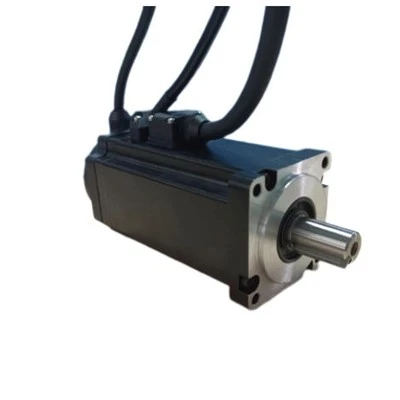
DC servomotors are essential components in a wide range of industrial and automation applications, offering precise control over speed, position, and torque. One of the key elements that contribute to the high - performance and accuracy of DC servomotors is the encoder. Encoders play a crucial role in providing feedback to the motor control system, enabling it to make real - time adjustments and ensure optimal operation. As a DC Servomotor supplier, I'd like to delve into the different types of encoders used in DC servomotors.
Incremental Encoders
Incremental encoders are one of the most commonly used types of encoders in DC servomotors. They work by generating a series of pulses as the motor shaft rotates. Each pulse represents a specific angular displacement of the shaft. The number of pulses counted over a given time period can be used to determine the speed of the motor, while the total number of pulses can be used to calculate the position of the motor shaft.
The basic principle of an incremental encoder involves a rotating disk with evenly spaced slots or markings. As the disk rotates, a light source and a photodetector are used to detect the passing of these slots. When a slot passes between the light source and the photodetector, a pulse is generated. Incremental encoders can be further classified into two - channel (A and B) and three - channel (A, B, and Z) encoders.
The two - channel incremental encoder provides two sets of pulses (A and B) that are 90 degrees out of phase with each other. This phase difference allows the control system to determine the direction of rotation of the motor shaft. If the A pulse leads the B pulse, the motor is rotating in one direction, and if the B pulse leads the A pulse, the motor is rotating in the opposite direction.
The three - channel incremental encoder adds a third pulse (Z) which is used as a reference or index signal. The Z pulse is generated once per revolution of the motor shaft, providing a known position reference point. This is particularly useful for applications where absolute position information is required at startup.
Incremental encoders are relatively simple and cost - effective, making them a popular choice for many DC servomotor applications. They are suitable for applications where relative position and speed control are sufficient, such as conveyor systems, robotic arms, and simple automation tasks. For more information about DC servomotors that can be paired with incremental encoders, visit DC Servomotor.
Absolute Encoders
Absolute encoders, on the other hand, provide a unique digital code for each position of the motor shaft. Unlike incremental encoders, which only provide relative position information, absolute encoders can directly determine the absolute position of the motor shaft without the need for a reference point or homing operation.
There are two main types of absolute encoders: single - turn and multi - turn. Single - turn absolute encoders can provide the absolute position of the motor shaft within one revolution. They use a series of concentric tracks on a rotating disk, each with a different number of segments. The combination of these segments creates a unique binary code for each angular position within one revolution.
Multi - turn absolute encoders can provide the absolute position of the motor shaft over multiple revolutions. They typically use a combination of gears and additional sensors to track the number of revolutions as well as the angular position within each revolution.
Absolute encoders are more complex and expensive than incremental encoders, but they offer several advantages. They are ideal for applications where accurate absolute position information is required, such as in machine tools, medical equipment, and high - precision robotics. The ability to provide absolute position information immediately at startup makes them suitable for applications where power interruptions or sudden stops are common, as the system can resume operation without the need for a homing cycle.
Magnetic Encoders
Magnetic encoders are another type of encoder used in DC servomotors. They operate based on the principle of magnetic field detection. A magnetic encoder consists of a magnetic disk with alternating north and south poles and a magnetic sensor. As the magnetic disk rotates with the motor shaft, the magnetic sensor detects the changes in the magnetic field and generates electrical signals.
Magnetic encoders offer several advantages. They are relatively immune to dust, dirt, and moisture, making them suitable for harsh industrial environments. They also have a long lifespan and are less prone to mechanical wear compared to optical encoders. Additionally, magnetic encoders can operate at high speeds, making them suitable for high - speed DC servomotor applications.
However, magnetic encoders may have lower resolution compared to optical encoders. The magnetic field can also be affected by external magnetic sources, which may require additional shielding or compensation techniques.
Optical Encoders
Optical encoders are widely used in DC servomotors due to their high resolution and accuracy. They work by using a light source, a rotating disk with patterns, and a photodetector. The rotating disk has a series of transparent and opaque patterns. As the disk rotates, the light from the light source passes through the transparent patterns and is detected by the photodetector, generating electrical pulses.
Optical encoders can provide very high resolution, with some models capable of providing thousands of pulses per revolution. This high resolution allows for precise control of the motor position and speed. They are commonly used in applications where high - precision motion control is required, such as in semiconductor manufacturing equipment, precision CNC machines, and high - end robotics.
However, optical encoders are more sensitive to dust, dirt, and moisture compared to magnetic encoders. They also require a clean and stable environment to operate effectively. Any contamination on the disk or the optical components can cause errors in the encoder output.
Choosing the Right Encoder for Your DC Servomotor
When selecting an encoder for a DC servomotor, several factors need to be considered. These include the required resolution, accuracy, operating environment, cost, and the specific application requirements.
If relative position and speed control are sufficient, and cost is a major concern, an incremental encoder may be the best choice. Incremental encoders are simple, cost - effective, and suitable for a wide range of applications.
For applications where absolute position information is required, such as in high - precision motion control systems, an absolute encoder is recommended. Although they are more expensive, they provide immediate and accurate position information without the need for a homing operation.
In harsh industrial environments where dust, dirt, and moisture are present, magnetic encoders may be a better option due to their robustness and immunity to environmental factors.
For applications that require high - resolution and high - accuracy motion control, optical encoders are the preferred choice. They offer the highest level of precision but require a clean and stable operating environment.


As a DC Servomotor supplier, we understand the importance of choosing the right encoder for your specific application. We offer a wide range of DC servomotors and encoders to meet your needs. If you are interested in learning more about our products or have any questions about encoder selection, please feel free to contact us for a procurement discussion. Our team of experts is ready to assist you in finding the best solution for your application. If you are also interested in other types of motors, such as Brushless AC Servo Motor, we can provide relevant information as well.
References
- Johnson, M. (2018). Encoder Technology for Motion Control. Motion Control Magazine.
- Smith, A. (2019). Servomotor Systems: Principles and Applications. Industrial Press.
- Brown, C. (2020). Encoder Selection Guide for DC Servomotors. Automation World.