Low-Inertia vs Medium-Inertia vs High-Inertia Servo Motors: How to Choose
When selecting a servo motor, power and torque are usually the first specifications people check.
They matter, but they do not tell the whole story.
For machines that need frequent acceleration, accurate positioning or rapid direction changes, motor inertia can have a major influence on how the axis behaves.
This is why servo motors are often offered in low-, medium- and high-inertia versions.
The terms may sound technical, but the basic idea is straightforward: different machines place different demands on the motor, and the rotor inertia should suit the load and motion profile.
What Does Servo Motor Inertia Mean?
Inertia describes how strongly an object resists a change in rotational speed.
A rotor with lower inertia is generally easier to accelerate and decelerate. A rotor with higher inertia requires more torque to change speed, but it can suit systems where the connected mechanical load and motion profile call for a different balance between response and stability.
This does not mean that low inertia is always faster or that high inertia is always better for heavy machinery.
Servo performance depends on the complete system, including motor inertia, load inertia, gearbox or transmission, acceleration time, required speed, available peak torque and servo-drive tuning.
A motor that performs well on one machine may behave very differently when connected to another load.
What Is a Low-Inertia Servo Motor?
A low-inertia servo motor uses a rotor designed to minimize rotational inertia.
Because less torque is required to change rotor speed, this type of motor is well suited to applications with frequent starts, stops, reversals and short motion cycles.
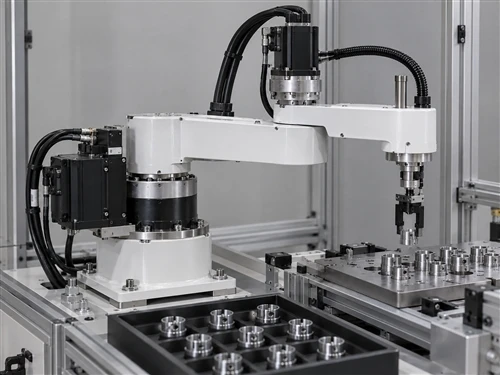
Typical applications include robotic joints, pick-and-place systems, packaging equipment and other machines where the axis needs to respond quickly.
Low inertia is particularly useful when the mechanical load is also relatively light or when the transmission system keeps the reflected load inertia within a range the servo system can control effectively.
Where Jiangnan Low-Inertia Motors Fit
Jiangnan Electric's current servo catalogue includes A and B Series permanent-magnet servo motors within its low-inertia range. The A Series uses higher-voltage configurations, while the B Series includes 48 V products intended for applications such as AGVs and medical robots. The catalogue also highlights broad compatibility with incremental, absolute and other feedback devices.
For example, the 40B Series includes a 0.1 kW configuration with 0.32 N·m rated torque and a 3,000 rpm rated operating point. Jiangnan's current website lists both low-voltage and higher-voltage servo families across several frame sizes.
A low-inertia motor can therefore be a good starting point when the machine requires rapid motion in a compact package.
What Is a Medium-Inertia Servo Motor?
A medium-inertia servo motor sits between the two ends of the range.
Instead of minimizing rotor inertia as much as possible, the design provides a more moderate inertia level that can suit machines where the load is neither extremely light nor strongly dominated by high-inertia mechanics.
This can be useful in industrial robots, handling equipment and other automated machines where the axis needs both responsive movement and stable load control.
The important point is that medium inertia should not be treated as a compromise product.
For the right application, it may provide a better motor-to-load match than either a very low-inertia or very high-inertia design.
Jiangnan Electric's current product structure places the C Series in the medium-inertia category, with a low-voltage platform intended for applications including industrial robots and material-handling robots.
What Is a High-Inertia Servo Motor?
A high-inertia servo motor has a rotor with greater rotational inertia.
That changes how the motor responds to acceleration and deceleration.
In applications with substantial load inertia, a higher-inertia motor can sometimes provide a more suitable relationship between the motor and the driven mechanism. It may also be useful where smooth and stable motion is more important than achieving the fastest possible acceleration.
However, high inertia should not be interpreted simply as "for heavier loads."
The required torque, cycle time, transmission ratio and servo-drive capacity still need to be checked.
Jiangnan's current high-inertia servo range includes D, E and S Series configurations. Current product information also lists high-inertia permanent-magnet servo products with high peak torque capability, high-speed operation on relevant models and multiple encoder options.
Why Load Inertia Matters
The servo motor does not accelerate only its own rotor.
It also has to control the mechanical load connected to the shaft.
That load may include a robot arm, pulley, ball screw, gearbox, conveyor roller, machine table or another rotating mechanism.
From the servo drive's point of view, the important factor is the load inertia reflected back to the motor shaft.
This is why simply telling a motor supplier that a machine carries "a 50 kg load" is usually not enough.
The same 50 kg load can create very different inertia depending on how far the mass is from the axis, whether the motion is rotary or linear, pulley or screw dimensions, gearbox ratio, machine geometry and required acceleration.
A gearbox can also change the inertia reflected to the motor, which is one reason servo selection should consider the transmission rather than the motor in isolation.
Low Inertia Does Not Always Mean Better Performance
Low-inertia motors are often associated with fast response, which is correct in many applications.
But that does not mean the lowest-inertia motor should automatically be selected.
If the connected load inertia is much larger than the motor inertia, the servo system may become more difficult to tune and control.
The drive may need to work harder during acceleration and deceleration, and the final machine response may not be as smooth as expected.
Likewise, selecting a motor with unnecessarily high rotor inertia can reduce acceleration performance and may require more torque to achieve the same motion cycle.
The objective is not to choose the lowest or highest possible inertia.
The objective is to create a reasonable match between the motor, load and required motion.
Start with the Motion Cycle
One of the most useful questions during servo selection is: What does the axis actually do during one machine cycle?
Consider a packaging machine.
One axis may move a lightweight mechanism forward and backward hundreds of times per minute. Fast acceleration and deceleration are essential, so a low-inertia servo motor may be appropriate.
Another axis on the same machine may rotate a larger roll continuously with fewer speed changes. Its motor-selection priorities may be different.
This is why two motors with the same power rating can behave very differently in the same machine.
The movement itself matters.
Do Not Ignore Peak Torque
In servo applications, rated torque tells only part of the story.
A motor may operate most of the time at relatively moderate torque but require much more torque for a fraction of a second during acceleration.
That is where peak torque becomes important.
Jiangnan's servo range includes product families designed with short-duration overload capability for dynamic operation. Current catalogue and website information show both rated and peak torque as separate selection parameters across the product range.
When evaluating a motor, the complete motion cycle should therefore be checked: accelerate, run, decelerate, stop, reverse and repeat.
The motor must satisfy both the continuous thermal requirement and the short-duration dynamic requirement.
Speed Is Part of the Same Calculation
Servo selection should also consider both rated speed and maximum speed.
A machine may normally operate at 2,000 rpm but briefly require 4,000 or 5,000 rpm during part of the cycle.
The motor must be able to reach that speed while still supplying the torque required by the application.
Jiangnan's current servo portfolio includes compact products such as the 15D, 20E and 25D/25E Series as well as larger 40, 60, 80 and 130 frame products. Depending on the series, published specifications cover different power, torque and speed ranges.
This allows the motor to be selected around the machine rather than forcing every application into one frame size.
Encoder Choice Also Matters
Motor inertia affects mechanical response, but the feedback system affects how accurately that response can be controlled.
Servo systems may use incremental encoders, absolute encoders, magnetic encoders or resolvers depending on the application.
Jiangnan's current servo catalogue includes compatibility with several feedback technologies across its product families.
The encoder should be selected according to the servo drive, positioning requirement, startup behavior and operating environment.
A higher encoder resolution alone does not automatically make the entire machine more accurate. Mechanical backlash, rigidity, transmission error and control tuning also affect final positioning performance.
How Should an OEM Choose the Right Inertia Class?
There is no single universal rule that says a certain machine must always use a low-, medium- or high-inertia motor.
Servo-motor manufacturers may also define inertia categories somewhat differently.
For an OEM project, the most useful information to provide is the actual operating condition of the axis.
That normally includes the required rated and peak torque, speed range, load inertia, acceleration and deceleration time, transmission ratio, servo-drive voltage, encoder requirement, mounting dimensions and operating environment.
If the load inertia is not known, a mechanical drawing of the axis can often help the engineering team estimate it.
For a replacement project, the existing motor nameplate, motor drawing and servo-drive model are also valuable.


Hangzhou Jiangnan Electric Servo Motor Options
Hangzhou Jiangnan Electric Motor Co., Ltd. currently offers permanent-magnet servo motors across low-, medium- and high-inertia product ranges, with multiple frame sizes, voltage platforms and feedback configurations.
The product structure reflects different application requirements rather than treating every servo axis in the same way.
For example, low-voltage B Series products are relevant to applications such as AGVs and compact robotic systems, while higher-voltage A Series products address another class of industrial automation equipment. Jiangnan's broader servo portfolio also covers medium- and high-inertia configurations for industrial robots, material-handling systems, collaborative robots and other machinery.
The broader application base includes industrial robots, collaborative robots, AGVs, CNC machine tools, packaging machinery, textile machinery and other automated equipment.
For OEM development, the selection process can begin with the machine requirements and then narrow down the appropriate frame size, inertia class, power level, encoder and mechanical configuration.
Choose the Motor for the Machine, Not the Label
Low-, medium- and high-inertia servo motors are not three levels of product quality.
They are different engineering options.
A low-inertia motor may be the right choice for a fast, lightweight robotic axis.
A medium-inertia motor may better suit a machine that needs balanced dynamic response and load control.
A high-inertia motor may be appropriate where the connected mechanism and motion profile favor greater rotor inertia.
The correct choice depends on the complete servo axis.
Before selecting a motor, define the load, speed, acceleration, transmission and positioning requirements first. Once those conditions are clear, the motor's inertia becomes a useful selection parameter rather than just another number in the catalogue.
For OEM and replacement projects, Jiangnan Electric can review an existing motor nameplate, mechanical drawing, load information and servo-drive specifications before recommending an appropriate servo motor configuration.
Disclaimer
The information in this article is provided for general reference only. Product specifications, performance, configuration options and suitability must be evaluated in detail for the intended application and actual operating conditions. Before selecting, purchasing or using a product, please confirm the relevant details with Jiangnan Electric and refer to the applicable technical documentation and agreed specifications. This article does not replace product-specific instructions or a professional engineering assessment.