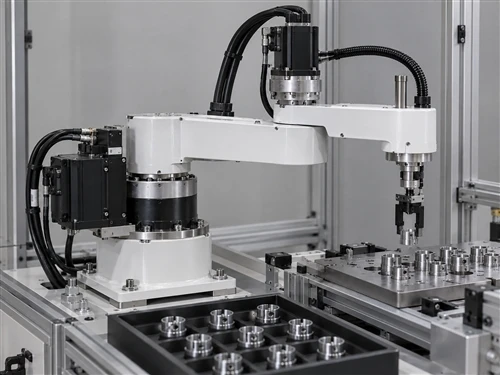
Rotary Servo Motor vs Other Servo Motor Types: What Is the Difference?
Servo motors are widely used in industrial automation when a machine needs controlled position, speed or torque.
But terms such as rotary servo motor, linear servo motor, torque motor and direct-drive servo motor are sometimes used together in a way that makes motor selection more confusing than it needs to be.
The easiest way to understand the difference is to start with one question: What type of motion does the machine actually need?
For most industrial equipment, the answer is either rotational motion or linear motion.
What Is a Servo System?
A servo motor normally operates as part of a closed-loop motion-control system.
A typical servo system includes:
- a servo motor;
- a servo drive;
- an encoder or other feedback device;
- a PLC, motion controller or other control system;
- the mechanical load.
The feedback device reports the motor's operating condition to the drive or controller, allowing the system to adjust motor output according to the commanded position, speed or torque.
This is why servo performance should be considered at the system level rather than from the motor alone.
What Is a Rotary Servo Motor?
A rotary servo motor produces rotational motion at its shaft.
This is the conventional servo motor configuration used in a wide range of industrial machines.
Depending on the mechanical design, the motor shaft may drive the load directly or through components such as:
- gearboxes;
- timing belts;
- pulleys;
- ball screws;
- rack-and-pinion systems.
Rotary servo motors are commonly used in robot joints, CNC machines, packaging equipment, material-handling systems and other automated machinery.
Their main advantage is flexibility.
Machine designers can select different motor sizes, torque levels, speeds, inertia characteristics and mechanical transmissions according to the requirements of each axis.
How Is a Linear Servo Motor Different?
A linear servo motor produces linear force and motion directly rather than producing rotation at an output shaft.
In a conventional rotary system, linear movement is often created by combining a rotary servo motor with a ball screw, belt or rack-and-pinion mechanism.
A linear motor can eliminate this rotary-to-linear conversion.
This can be useful in machines requiring high-speed linear positioning, rapid acceleration or a mechanically simple direct-drive axis.
However, linear motors are not automatically the better solution.
They may require different machine structures, feedback arrangements, thermal management and installation considerations.
For many automation systems, a conventional rotary servo motor combined with an appropriate mechanical transmission remains the more practical option.
Is a Torque Motor Different from a Rotary Servo Motor?
Not necessarily.
A torque motor is generally a rotary motor designed to provide relatively high torque at low rotational speed.
Many torque motors are used as direct-drive rotary motors, meaning the motor is connected directly to the machine load without a gearbox or belt transmission.
So it is more accurate to think of a torque motor as a specialized rotary drive solution rather than as the opposite of a rotary servo motor.
For applications such as rotary tables or large precision axes, eliminating the gearbox can reduce backlash and mechanical transmission components.
The trade-off is that the motor itself must provide the required load torque directly.
What Does "Direct Drive" Mean?
Direct drive describes the way the motor connects to the load.
It is not a separate motion category.
Both rotary and linear motors can use a direct-drive architecture.
In a conventional rotary servo system, a gearbox or other transmission may sit between the motor and the load.
In a direct-drive rotary system, the motor drives the load without this intermediate transmission.
Direct drive can reduce backlash, mechanical wear and the number of transmission components, but it also changes the motor-sizing requirements.
The motor must be selected according to the actual load torque, speed and inertia.
For Most Industrial Machines, Inertia Matters More Than the Label
Once a machine builder has decided to use a rotary servo motor, another question becomes important:
What motor inertia is appropriate for the load and motion profile?
Rotor inertia affects how easily the motor can accelerate, decelerate and control the connected load.
This is why Jiangnan Electric's current permanent-magnet servo portfolio is organized into low-, medium- and high-inertia servo motor ranges rather than simply presenting all rotary servo motors as one category.
Low-Inertia Servo Motors
Low-inertia motors are useful where rapid acceleration, deceleration and frequent direction changes are important.
Jiangnan's current low-inertia range includes D, E, A and B Series configurations.
The A Series is a 220-380 V platform used for applications such as SCARA and delta robots, while the B Series includes 48 V configurations intended for applications such as AGVs and medical robots.
For example, Jiangnan's B Series 40 Frame Permanent Magnet Servo Motor includes a 48 V, 0.1 kW version with 0.32 N·m rated torque and a 3,000 rpm rated speed, together with encoder options.
This type of compact low-inertia motor is relevant where the machine requires fast changes in speed or direction within a limited installation space.
Medium-Inertia Servo Motors
A medium-inertia motor can provide a different balance between dynamic response and load matching.
Jiangnan's current catalogue places the C Series in this category, with a low-voltage platform intended for applications including industrial robots and material-handling robots.
For machine builders, the important point is not that medium inertia is universally better than low inertia.
The correct choice depends on the inertia of the actual load and the required motion cycle.
High-Inertia Servo Motors
High-inertia motors are another option for axes where the connected mechanical load and operating profile favor a higher rotor inertia.
Jiangnan's product range includes D, E and S Series high-inertia servo motors.
The 60D Permanent Magnet Synchronous Servo Motor, for example, belongs to this high-inertia product direction rather than representing a fundamentally different type of servo technology.
This distinction is important because selecting a servo motor by power alone does not guarantee good dynamic performance.
What Should You Compare When Selecting a Rotary Servo Motor?
For an OEM or machine-building project, the motor type is only the beginning.
Rated and peak torque. The motor needs sufficient continuous torque for normal operation and sufficient peak torque for acceleration and short-duration overload conditions.
Rated and maximum speed. The required machine cycle determines the motor speed range.
Load inertia. This affects acceleration, deceleration and servo tuning.
Supply and drive voltage. The motor must be compatible with the servo drive and machine electrical architecture.
Encoder. Feedback type and resolution should be compatible with the control system and accuracy requirement.
Holding brake. A brake may be required for vertical axes or loads that must remain in position when motor power is removed.
Mechanical dimensions. Flange size, shaft dimensions and total motor length are particularly important for replacement projects.
Operating environment. Temperature, humidity, ingress protection and other environmental conditions should match the actual machine.


Jiangnan Electric Servo Motor Portfolio
Hangzhou Jiangnan Electric Motor Co., Ltd. currently offers a permanent-magnet servo motor portfolio covering different frame sizes, voltages, power levels and inertia classes.
The current product structure separates the range into Low-Inertia, Medium-Inertia and High-Inertia Servo Motors.
The broader servo family supports multiple feedback options and application-specific configurations for industrial robots, collaborative robots, AGVs, CNC machine tools, packaging machinery, textile equipment and other automated machinery.
Examples from the current portfolio include:
- A/B Series: low-inertia configurations for high- and low-voltage applications;
- C Series: medium-inertia configurations;
- D/E/S Series: high-inertia options;
- compact 15D, 20E and 25D/25E products for smaller servo applications.
The correct series depends on the actual machine rather than on a single specification.
Rotary, Linear or Direct Drive: Start with the Machine
There is no single servo motor architecture that is best for every machine.
For most conventional automation axes requiring rotational output, a rotary permanent-magnet servo motor is a practical and flexible solution.
A linear servo motor becomes relevant when direct linear motion is required.
A direct-drive rotary or torque motor may make sense when eliminating mechanical transmission is valuable.
After the motion architecture has been selected, the next step is to match the motor's torque, speed, inertia, voltage, feedback and mechanical dimensions to the load.
For OEM and replacement projects, providing the existing motor nameplate, mechanical drawing, load information and servo-drive model allows Jiangnan Electric's engineering team to evaluate the application more accurately.
Disclaimer
The information in this article is provided for general reference only. Product specifications, performance, configuration options and suitability must be evaluated in detail for the intended application and actual operating conditions. Before selecting, purchasing or using a product, please confirm the relevant details with Jiangnan Electric and refer to the applicable technical documentation and agreed specifications. This article does not replace product-specific instructions or a professional engineering assessment.